From issuing tax invoices to filing monthly VAT returns, VAT plays an important role in day-to-day operations. Understanding your VAT obligations early — alongside related taxes such as Withholding Tax in Thailand — can help you avoid costly mistakes and stay compliant with Thai tax regulations.
This guide covers the key aspects of VAT in Thailand, including registration requirements, VAT rates, tax calculations, filing deadlines, and practical compliance tips.
What is Value Added Tax (VAT) in Thailand?
Value Added Tax (VAT) is an indirect tax imposed under the Thai Revenue Code on the sale of goods, the provision of services, and the importation of goods into Thailand.
Unlike Personal Income Tax or Corporate Income Tax (CIT) — both of which are taxes on income — VAT is charged on the value added to goods and services at each stage of the supply chain. and is ultimately paid by the final consumer.
VAT-registered businesses collect VAT from customers and remit it to the Thai Revenue Department after deducting eligible Input VAT.
Because VAT applies to most business transactions, it directly affects pricing, purchasing, accounting records, and monthly tax reporting. Understanding how VAT works is therefore an important part of running a business in Thailand.
Output VAT
Output VAT is the VAT collected from customers when a VAT-registered business sells taxable goods or provides taxable services.
For example:
| Description | Amount |
| Sales Value | THB 100,000 |
| VAT (7%) | THB 7,000 |
| Total Invoice | THB 107,000 |
In this example, the business collects THB 7,000 in Output VAT, which is reported in its monthly VAT return.
Input VAT
Input VAT is the VAT paid on purchases or expenses incurred for business purposes.
Common examples include:
- Inventory purchases
- Raw materials
- Office supplies
- Advertising expenses
- Professional service fees
- Utility expenses
- Business software
- Office equipment
Businesses may generally claim input tax credit in Thailand if the purchase is supported by a valid tax invoice and complies with the requirements of the Thai Revenue Code. However, not all VAT paid on business purchases can be claimed as an input tax credit. Certain purchases and expenses are specifically excluded under Thai tax law.
VAT Payable
The amount of VAT payable is calculated by deducting Input VAT from Output VAT.
VAT Payable = Output VAT − Input VAT
If Output VAT exceeds Input VAT, the difference must be paid to the Revenue Department.
If Input VAT exceeds Output VAT, the excess may generally be carried forward to future VAT periods or claimed as a VAT refund in Thailand, subject to the Revenue Department's requirements.
Who Must Register For VAT In Thailand?
Not every business in Thailand is required to register for VAT. Whether registration is required depends mainly on the business's annual revenue and the nature of its activities.
Businesses may register because they are legally required to do so or because voluntary registration offers commercial and tax benefits.
Mandatory VAT Registration
The VAT registration threshold in Thailand is THB 1.8 million in gross annual revenue from taxable activities. (This threshold is based on sales for VAT purposes, which may differ from revenue recognized for accounting purposes.) Businesses that exceed this threshold are required to register for VAT.
The VAT registration application must be submitted within 30 days after the registration threshold is exceeded.
Businesses required to register for VAT include:
- Trading companies
- Manufacturers
- Restaurants and cafés
- Hotels
- Construction companies
- Consulting firms
- Marketing agencies
- Software and technology companies
- E-commerce businesses
- Importers and exporters
Failure to register on time may result in penalties under the Thai Revenue Code.
Voluntary VAT Registration
Businesses with annual revenue below THB 1.8 million may also choose to register voluntarily.
Voluntary registration may be beneficial because it allows businesses to:
- Claim eligible Input VAT credits
- Issue tax invoices
- Improve credibility with customers and suppliers
Many start-ups choose voluntary registration because they incur significant VAT-bearing expenses before generating substantial revenue.
Businesses Exempt from VAT
Certain businesses and activities are exempt from VAT under the Thai Revenue Code.
Examples include, but are not limited to:
- Certain agricultural products
- Animal feed, fertilizers, and agricultural chemicals
- Educational services provided by qualifying educational institutions
- Medical services
- Domestic transportation services
Businesses making only VAT-exempt supplies are not required to register for VAT and cannot normally claim Input VAT on purchases relating to those exempt activities.
VAT rates in Thailand
Understanding the correct VAT rate is essential for issuing tax invoices, calculating VAT correctly, and complying with Thai tax regulations.
While most business transactions are subject to the standard VAT rate, some transactions qualify for a 0% VAT rate or are exempt from VAT. Applying the correct treatment helps businesses avoid reporting errors and unnecessary tax assessments.
Standard VAT Rate
Thailand's standard VAT rate is currently 7% and generally applies to the sale of goods and the provision of services within Thailand.
Examples include:
- Sale of goods
- Professional services
- Manufacturing
- Consulting services
- Construction services
- Restaurants and hotels
- Software and IT services
VAT-registered businesses are generally required to charge 7% VAT and issue a valid tax invoice for taxable transactions.
Zero-Rated VAT (0%)
Certain transactions qualify for a 0% VAT rate.
Although no VAT is charged to the customer, these transactions are still considered taxable supplies. As a result, businesses may generally claim eligible Input VAT incurred in providing those goods or services.
Examples include:
- Export sales of goods
- Services performed in Thailand but wholly used outside Thailand (subject to the conditions prescribed by Thai tax law)
- International air and sea transport services
Example:
A Thai company exports products worth THB 500,000 to a customer in Japan.
- Sales Value: THB 500,000
- VAT Rate: 0%
- Output VAT: THB
Although no VAT is charged, the company may still be able to recover eligible Input VAT relating to the export.
VAT-Exempt Transactions
Some goods and services are VAT exempt in Thailand under the Thai Revenue Code.
Unlike zero-rated transactions, Input VAT incurred on purchases relating to VAT-exempt supplies generally does not qualify for a credit.
Examples include, but are not limited to:
- Certain agricultural products
- Animal feed, fertilizers, and agricultural chemicals
- Educational services provided by qualifying educational institutions
- Medical services
- Domestic transportation services
How is VAT calculated in Thailand?
Thailand uses a tax credit-invoice VAT system, which allows businesses to deduct eligible Input VAT from Output VAT.
The amount of VAT payable is calculated using the following formula:
VAT Payable = Output VAT − Input VAT
If Output VAT is greater than Input VAT, the difference must be paid to the Revenue Department.
If Input VAT exceeds Output VAT, the excess may generally be carried forward or claimed as a VAT refund, subject to the Revenue Department's requirements.
Step 1: Calculate Output VAT
Output VAT is the VAT collected from customers on taxable sales.
Example:
| Description | Amount |
| Sales Revenue | THB 500,000 |
| VAT (7%) | THB 35,000 |
| Total Tax Invoice | THB 535,000 |
The business reports THB 35,000 as Output VAT.
Step 2: Calculate Input VAT
Input VAT is the VAT paid on purchases used in the business.
Example:
| Description | Amount |
| Purchase Value | THB 200,000 |
| VAT Paid | THB 14,000 |
If the purchase is supported by a valid tax invoice and the VAT is claimable under Thai tax law, the THB 14,000 may generally be claimed as Input VAT.
Step 3: Calculate VAT Payable
| Description | Amount |
| Output VAT | THB 35,000 |
| Less: Input VAT | THB (14,000) |
| VAT Payable | THB 21,000 |
The business reports THB 21,000 as VAT payable in its monthly Form PP.30. (Monthly VAT Filing Form)
Example: Excess Input VAT
Businesses making significant investments or exporting goods may incur more Input VAT than Output VAT.
| Description | Amount |
| Output VAT | THB 18,000 |
| Input VAT | THB (30,000) |
| Excess Input VAT | THB 12,000 |
In this situation, the business may generally:
- Carry the excess Input VAT forward to future VAT periods
- Apply for a VAT refund in Thailand, subject to the Revenue Department's procedures.
How to Register for VAT in Thailand
Once a business is required to register for VAT, it must apply to the Thai Revenue Department within the prescribed time limit. Businesses may also choose to register voluntarily if they meet the applicable requirements.
Registration Process
Businesses may register for VAT either in person at the Revenue Department office responsible for their business location or online through the Revenue Department's D-VAT system.
The registration process generally involves the following steps:
- Prepare the required documents.
- Submit Form PP.01 together with the supporting documents.
- The Revenue Department reviews the application, and may request additional information or inspect the business premises if necessary.
- Receive the VAT Registration Certificate (Form PP.20) once the application is approved.
After registration, businesses must begin issuing tax invoices and filing monthly VAT returns in accordance with the Thai Revenue Code.
When to file and pay VAT returns in Thailand?
Once registered for VAT, businesses are required to file a monthly VAT return (Form PP.30), regardless of whether any VAT is payable.
A VAT return must generally be submitted even if:
- No sales were made during the month.
- No purchases were made.
- No VAT is payable.
- The business is in a VAT refund position.
Submitting a nil return, where applicable, is part of a business's ongoing VAT compliance obligations.
Filing and Payment Deadline
VAT-registered businesses must generally file Form PP.30 and pay VAT due by the 15th day of the month following the relevant tax period.
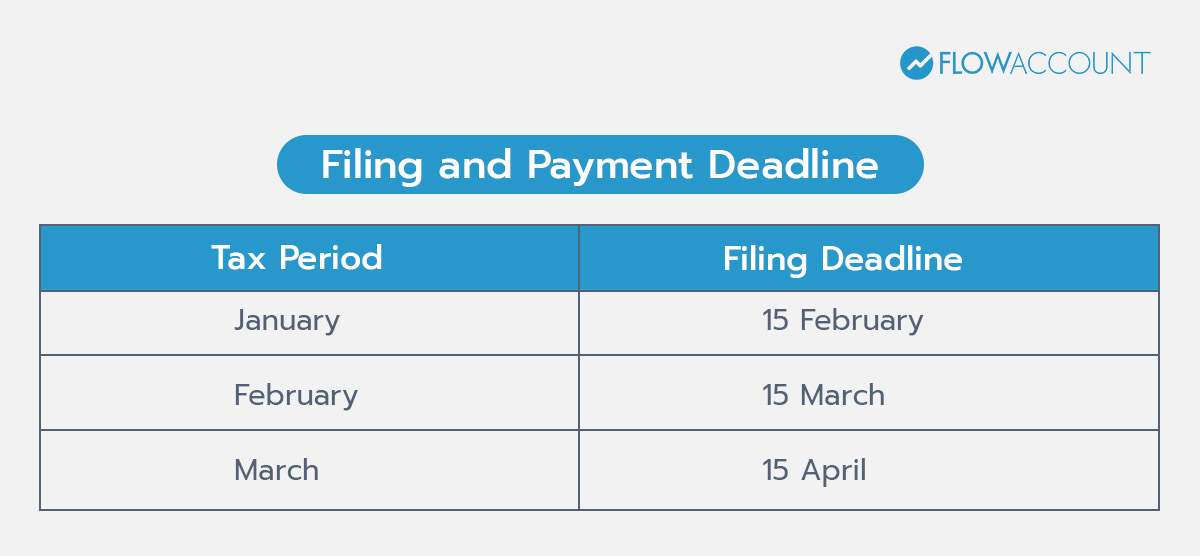
Businesses using e-filing for VAT in Thailand through the Revenue Department's online system may receive additional filing days, subject to the Revenue Department's announcements.
Late Filing and Payment
Failure to file Form PP.30 or pay VAT on time may result in:
- Filing penalties
- Surcharges
- Interest on unpaid VAT
- Increased risk of review or audit by the Revenue Department
Filing VAT returns accurately and on time helps businesses remain compliant and avoid unnecessary tax risks.
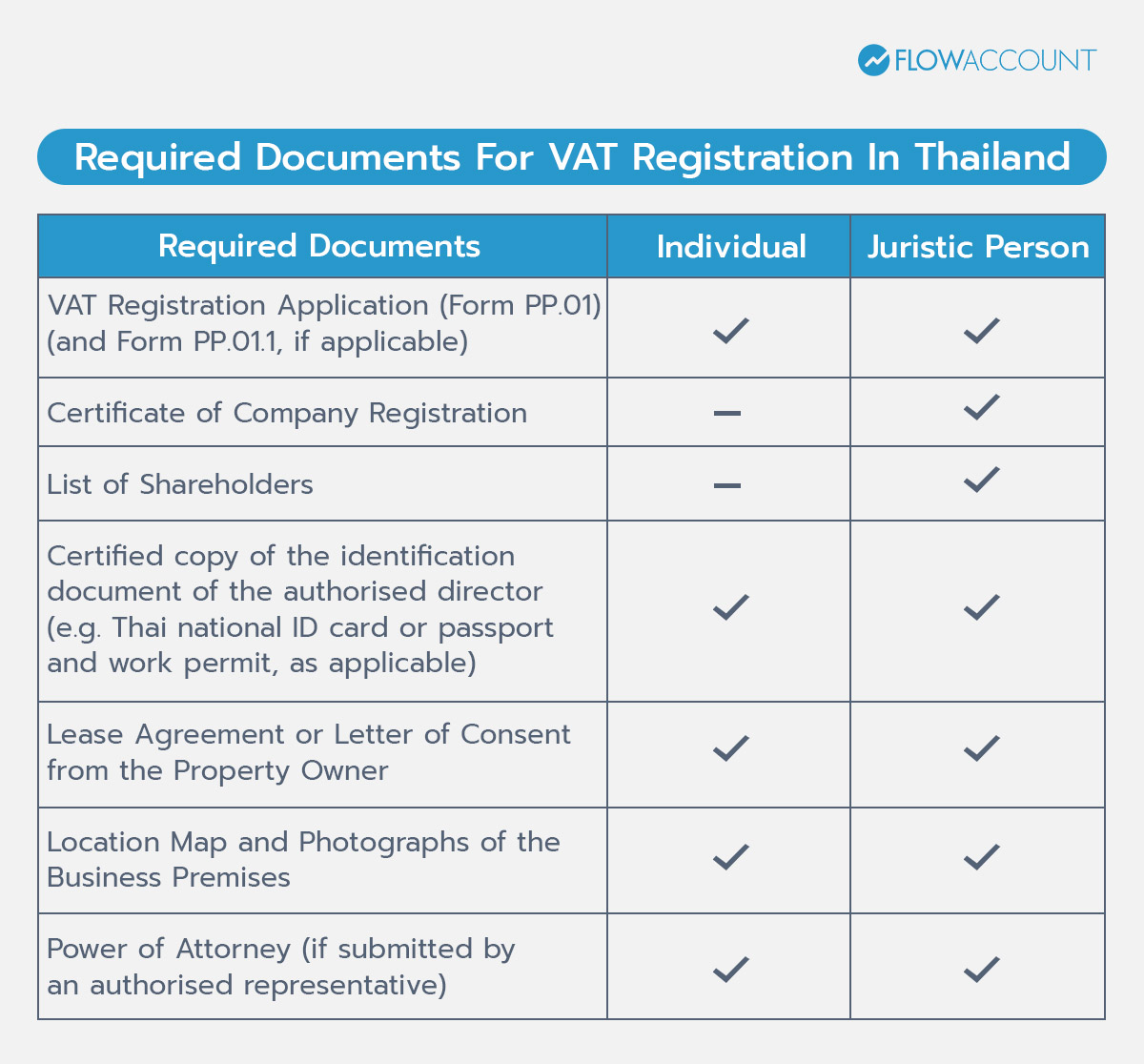
Required Documents For VAT Registration In Thailand
The documents required for VAT registration vary depending on the type of business and the applicant. The following are the documents most commonly required by the Thai Revenue Department.
VAT Compliance Tips for Businesses in Thailand
Maintaining proper VAT compliance helps businesses avoid penalties, reduce tax risks, and simplify monthly tax reporting. The following practices can help your business stay compliant:
- Issue tax invoices correctly in accordance with the Thai Revenue Code.
- Maintain accurate accounting records for all sales, purchases, and VAT transactions.
- Keep supporting documents, including tax invoices, receipts, and contracts, for future reference. Note that certain contracts may also be subject to Stamp Duty in Thailand.
- Review Input VAT carefully before claiming a tax credit to ensure it complies with Thai tax law.
- File Form PP.30 and pay VAT due on time each month.
- Seek professional advice if your business has complex transactions, international operations, or VAT uncertainties.
Manage VAT More Efficiently with FlowAccount
As your business grows, managing VAT manually becomes more complex and time-consuming. Preparing tax invoices, tracking Input and Output VAT, and filing monthly VAT returns all require accurate record-keeping and careful attention to detail.
FlowAccount helps simplify VAT compliance by enabling businesses to:
- Issue tax invoices electronically
- Record income and expenses in one place
- Track Output VAT and Input VAT automatically
- Calculate monthly VAT payable
- Store accounting records digitally
- Reduce manual calculations
By automating routine accounting tasks, FlowAccount helps businesses save time, reduce errors, and stay compliant with Thailand's VAT requirements.
Frequently Asked Questions About VAT In Thailand
1. What is the VAT rate in Thailand?
Answer: Thailand's standard VAT rate is currently 7%. However, certain transactions may qualify for the 0% VAT rate or be VAT-exempt under the Thai Revenue Code.
2. Is VAT registration mandatory in Thailand?
Answer: VAT registration depends on the nature of the business and its annual revenue. Businesses with gross annual revenue exceeding THB 1.8 million from taxable activities are generally required to register for VAT. Businesses below this threshold may register voluntarily if they meet the applicable requirements. Businesses making only VAT-exempt supplies are generally not required to register.
3. Can foreign companies register for VAT in Thailand?
Answer: Foreign companies may be required to register for VAT if they carry on taxable activities in Thailand. Whether registration is required depends on the scope and nature of their business activities in Thailand.
4. How often do businesses file VAT returns?
Answer: VAT-registered businesses are generally required to file Form PP.30 on a monthly basis, even if no VAT is payable or no business activity occurred during the relevant tax period.
5. What happens if VAT is filed late?
Answer: Late filing or payment of VAT may result in penalties, surcharges, and interest under the Thai Revenue Code. It may also increase the risk of review or audit by the Thai Revenue Department. Filing VAT returns on time helps businesses remain compliant and avoid unnecessary costs.
6. Can businesses claim VAT refunds?
Answer: If Input VAT exceeds Output VAT, businesses may generally carry the excess forward to future tax periods or apply for a VAT refund, where applicable.
About Author

ผู้สอบบัญชีรับอนุญาต (CPA) มีประสบการณ์ทำงานในสำนักงานสอบบัญชี Big 4 และให้คำปรึกษาด้านระบบบัญชีและภาษีสำหรับธุรกิจ SMEs ช่วยออกแบบขั้นตอนการทำงานและการจัดการเอกสารให้เป็นระบบ สอดคล้องกับการปฏิบัติงานจริง และเป็นไปตามกฎหมายบัญชีและภาษี เพื่อให้การดำเนินธุรกิจเป็นไปอย่างมั่นใจและตรวจสอบได้