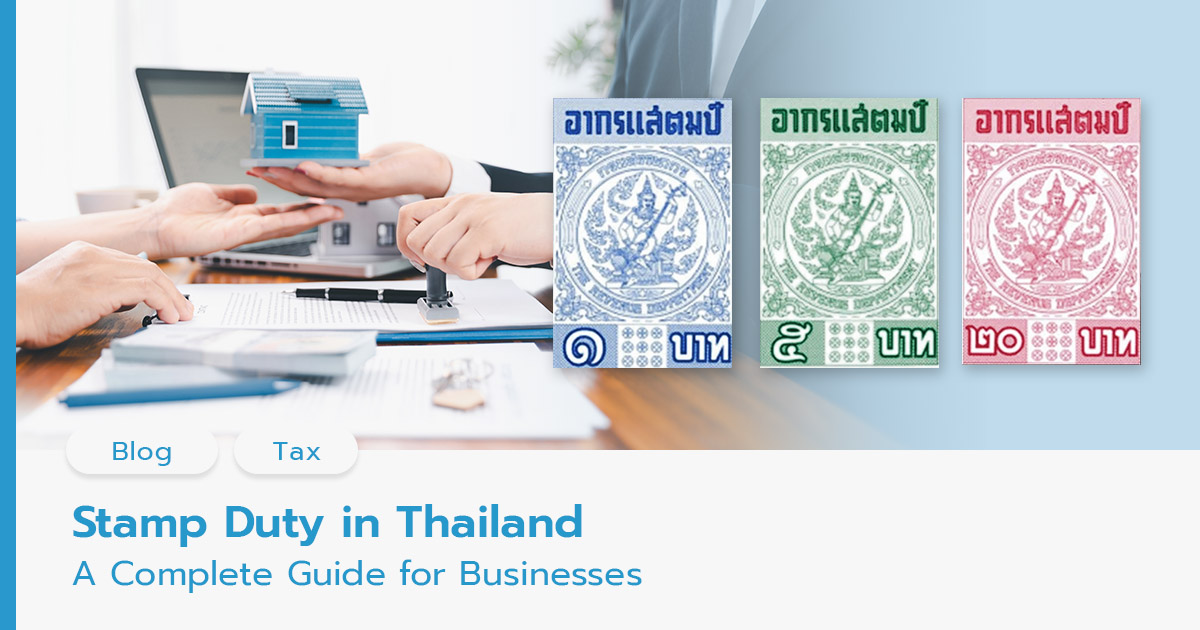
Although it may seem like a small detail, failing to pay stamp duty on certain documents and agreements can lead to penalties and legal risks, including rendering your contract inadmissible as evidence in court.
In this guide, we explain what stamp duty is, how it is calculated, who is responsible for payment, and how businesses can ensure compliance in Thailand.
What Is Stamp Duty in Thailand?
Stamp duty in Thailand is a tax imposed on certain legal documents and agreements under the Thai Revenue Code.
Stamp duty serves as both a tax obligation and a legal requirement for certain documents to be admissible as evidence in court.
In Thailand, stamp duty is typically paid either by affixing physical revenue stamps or through the Revenue Department’s electronic system, depending on the type of document.
What Documents Are Subject to Stamp Duty?
Under the Thai Revenue Code, stamp duty applies only to specific types of legal documents.
In total, there are 28 categories prescribed by law. (Schedule of Stamp Duty Rates attached to Chapter 6 of the Revenue Code)
In practice, businesses most commonly encounter the following documents:
Common examples include:
- Lease agreements
- Loan agreements
- Service contracts
- Hire purchase agreements
- Powers of attorney
- Pledge agreements
- Bill of exchange
Who Pays Stamp Duty in Thailand?
The party responsible for paying stamp duty depends on the type of document.
Common examples include:
- Lease agreement → The lessor (landlord) is responsible
- Loan agreement → The borrower is responsible
- Service contracts → The contractor/service provider is responsible
- Power of attorney → The grantor (person giving authority) is responsible
In practice, the parties to an agreement may mutually agree on who will bear the cost of stamp duty.
Stamp Duty Rates in Thailand
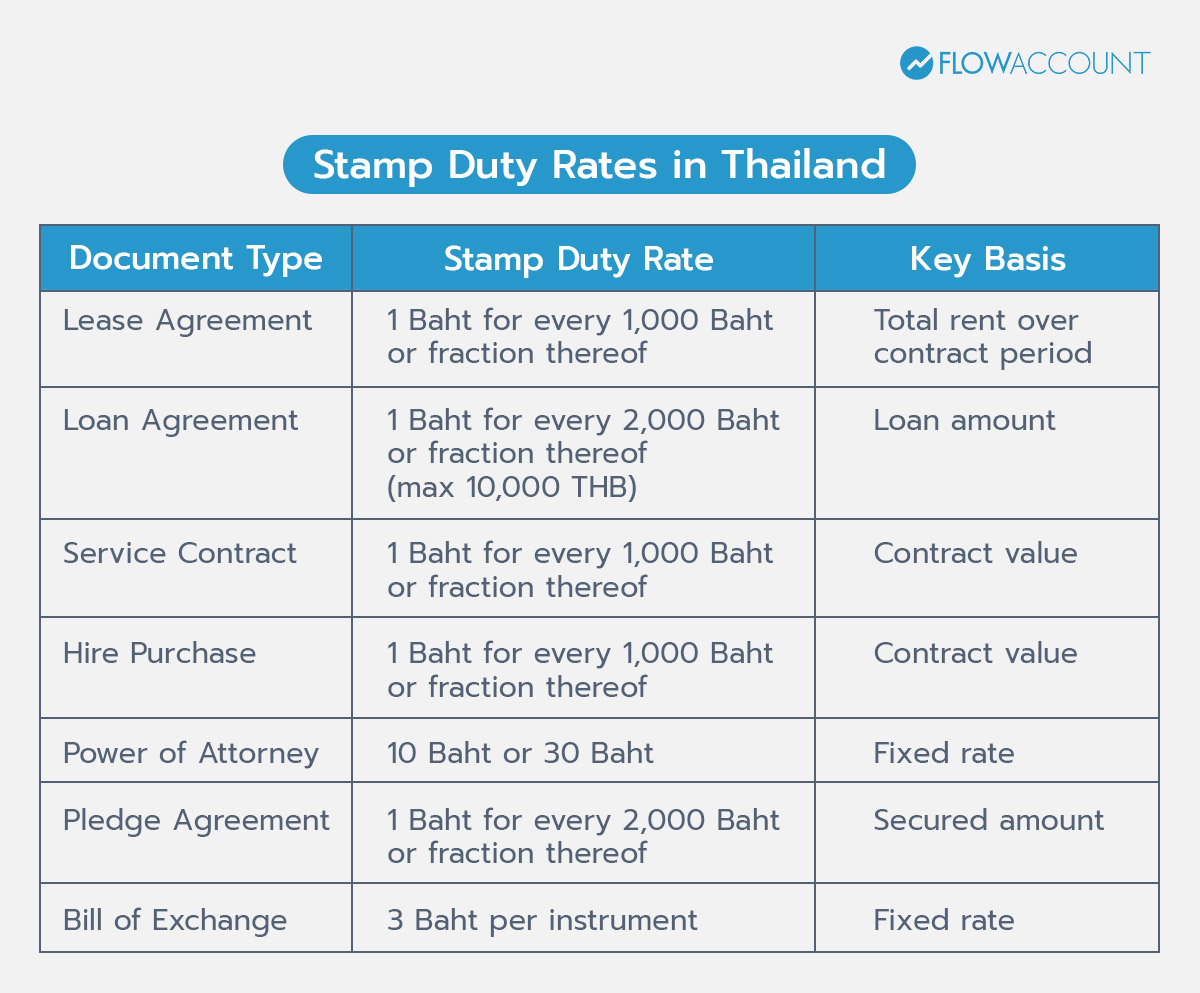
The stamp duty rate depends on the document type. Under Thai law, there are 28 types of instruments subject to stamp duty as prescribed by the Revenue Department.
Below are some of the most common contracts that businesses encounter, including the stamp duty rate and basis.
How to Pay Stamp Duty in Thailand
Currently, stamp duty in Thailand can be paid through several methods, making the process more straightforward for businesses. The main options are as follows:
1. Physical Stamps
This traditional method involves purchasing revenue stamps from the Revenue Department and affixing them to the document. To ensure the document is considered "duly stamped" and admissible as evidence in court, you must perform a proper "Cancellation."
2. E-Stamp Duty (Recommended)
Businesses can file and pay stamp duty through the Revenue Department’s online system:
https://efiling.rd.go.th/ef-cms-web/
No physical stamps are required. This method is ideal for businesses handling multiple documents or those that prefer digital record-keeping.
3. Filing and Payment at the Revenue Department Office
This method allows taxpayers to pay stamp duty in cash at a local Revenue Department office. It is applicable to specific types of instruments as prescribed by law.
Businesses should keep proof of payment together with the contract for audit and legal purposes.
Stamp Duty vs VAT: What’s the Difference?
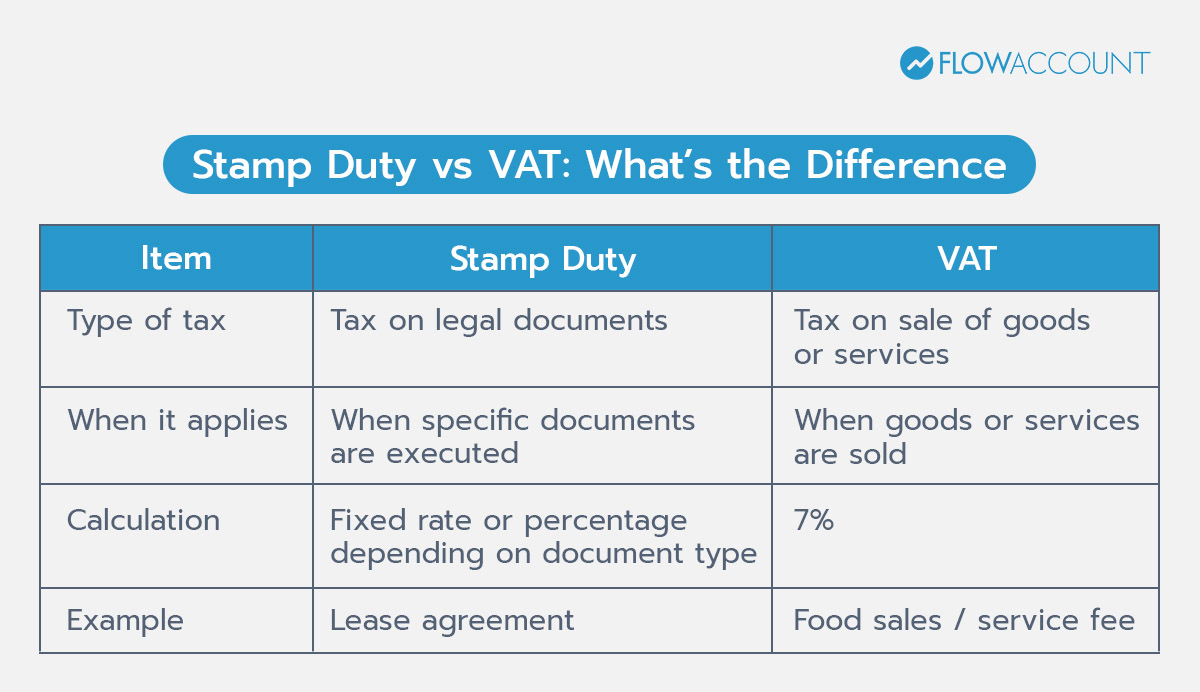
Many business owners confuse stamp duty with Value Added Tax (VAT), but these are two completely different types of taxes in Thailand.
Stamp Duty Compliance Tips for Businesses in Thailand
- Check whether your contract is subject to stamp duty based on its substance, not just its title.
- Ensure payment is made within 15 days of the execution date to avoid penalties.
- Clearly specify in the contract which party will be responsible for the payment
- Keep proper records of documents and payment for legal and audit purposes
- Be aware that unstamped documents may not be admissible in court until the duty and penalties are paid
Using an accounting system such as FlowAccount can also help businesses maintain contract records, payment evidence, and tax documents in one place.
(FAQs) Stamp Duty in Thailand
1. What is stamp duty?
Answer: Stamp duty is a tax imposed on specific legal documents such as contracts and agreements.
2. When do you need to pay stamp duty in Thailand?
Answer: Stamp duty must be paid within 15 days of the date the document is executed. For documents executed outside Thailand and later brought into use within the country, stamp duty must be paid within 30 days of the date the document is received by the user.
3. Who is responsible for paying stamp duty?
Answer: It depends on the document type and the terms agreed between the parties. The party specified by law remains primarily liable.
4. How is stamp duty calculated in Thailand?
Answer: Stamp duty calculation depends on the document type and may be a fixed amount or a percentage of the contract value.
5. What happens if stamp duty is not paid?
Answer: The document may not be legally enforceable in court, and penalties or surcharges may apply.
6. What documents require stamp duty in Thailand?
Answer: Stamp duty applies to specific types of legal documents as prescribed under the Thai Revenue Code. Common examples include:
- Lease Agreement
- Loan Agreement
- Service Contract
- Hire Purchase
- Power of Attorney
- Pledge Agreement
- Bill of Exchange
About Author

ผู้สอบบัญชีรับอนุญาต (CPA) มีประสบการณ์ทำงานในสำนักงานสอบบัญชี Big 4 และให้คำปรึกษาด้านระบบบัญชีและภาษีสำหรับธุรกิจ SMEs ช่วยออกแบบขั้นตอนการทำงานและการจัดการเอกสารให้เป็นระบบ สอดคล้องกับการปฏิบัติงานจริง และเป็นไปตามกฎหมายบัญชีและภาษี เพื่อให้การดำเนินธุรกิจเป็นไปอย่างมั่นใจและตรวจสอบได้